يستمر المهندس جعفر ضاهر في الانطلاق قدماَ في مجال الخلق والابتكار، وبالرغم من روعة ما ينثره في رحاب كل مشروع يحتضنه بيديه المبدعتين، يعلم انه لم يبلغ الحدود التي كان يطمح اليها، والأفكار التي كان يرغب في تقديمها لأسباب تعود الى محدودية المساحات والامكانيات الواقعية، لكن ذلك لا يثنيه عن إبداع المزيد، في كل مرة، من خلال فن متحرر من القيود.
وقد بات واضحاَ لمتتبعي أعمال المهندس ضاهر، تميزه بالجرأة في التعاطي مع المساحات الهندسية، وطبعه إياها بخصائص شخصيته القوية، ليمهرها بغزارة إبداعه الفني على مستوى الهندسة الداخلية الثابتة والمعمارية وتصميم الحدائق، مع تركيزه على الابتعاد عن كل ما هو مألوف ومتداول، حتى في أدق وابسط التفاصيل، فتأتي كل إطلالة له، لتكشف عن مكامن جديدة في طاقاته الخلاقة اللامتناهية.
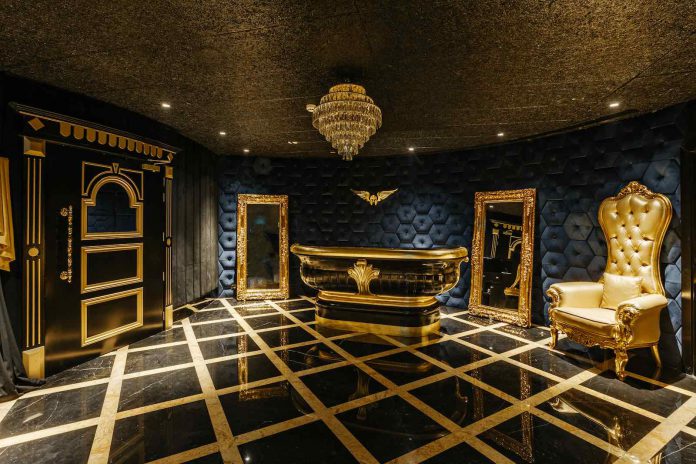
ويظهر المهندس ضاهر انه جريء، مقدام، خصب المخيلة ، غني بأفكاره وواسع بخبرته وقد تعود أن يترك أعماله ومشاريعه المنوَعة والمتجددة مهمة الحديث عنه. وآخرها هذا النايت كلوب الرائع في دبي وخير وصف ينطبق عليه هو الأناقة بكامل روعتها والفخامة.
مشروع متواضع بمساحته غني بجمالية تصاميمه الداخلية. مشغول بنفحة حديثة ممهورة بنقاوة الخطوط وصفاء التصميم. هي مواصفات أعمال المهندس جعفر ضاهر، صاحب الخبرة الطويلة والحضور الدائم والمميز في مجال الهندسة.
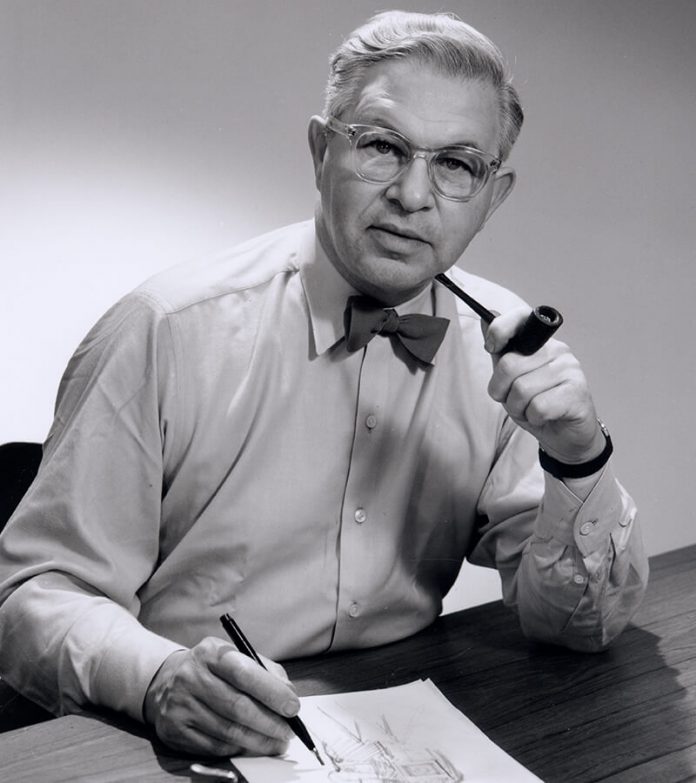
Arne Jacobsen (1902-1971) was the renaissance-man of Danish architecture and design. He mastered the whole gamut of the profession. Whether the object in question was a high-rise hotel, a chair or a door handle, he worked with an obvious enthusiasm and vigour.
Jacobsen was admitted to the Royal Academy of Fine Arts in 1924?from where he?graduated in 1927. In 1929 he won recognition for The House of the Future project, where he, in collaboration with Flemming Lassen, presented a daring vision complete with helipad on the rooftop.
One of Jacobsen?s greatest achievements was the Royal Hotel in Copenhagen, completed in 1960. It was undoubtedly one of the world?s finest examples of total environments. In everything from the elegant curtain-wall structure over the furniture, the lighting, the textiles, the door handles and down to the cutlery in the restaurant, Jacobsen?s creative talent was evident.?It was also here?some of his finest pieces of furniture were first introduced. The full bodied sculptural shapes of The Egg and The Swan, chairs that are now considered modern furniture icons, constituted an interesting contrast to the angular, stringent building.
Another well-known Jacobsen creation is The Ant chair designed in 1951 and introduced in 1952. This elegant stackable three-legged piece came about as a result of Jacobsen?s great interest in modern materials and new production techniques. The narrow ?waist?, which gave the chair its name, was necessary because of Jacobsen?s wish to keep the bent plywood seat and back in one piece. A four-legged sister, the chair model 3107 designed in 1955, went on to become a major success with more than 5 millions copies sold worldwide.
Throughout his career Arne Jacobsen maintained a high level of productivity. He designed a great number of single-family houses, summerhouses, factories, larger apartment buildings such as the Bellavista complex (1934), and several public buildings, such as S?ller?d and ?rhus Town Halls (1942) and Munkegaard Elementary School (1942). In 1964 St. Catherine?s College at Oxford University was inaugurated, earning him international fame.
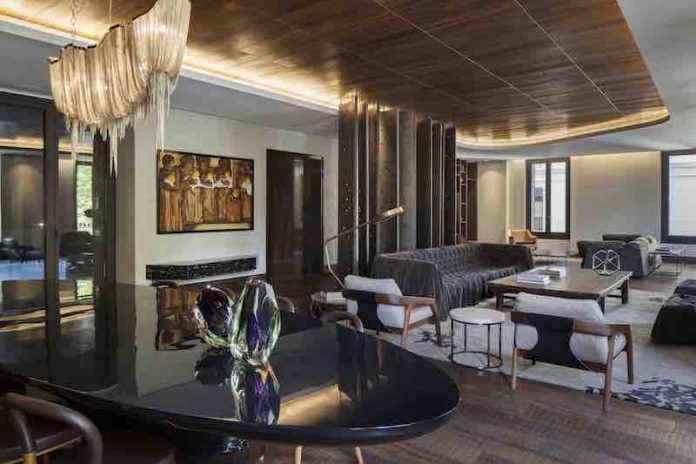
As well as the Afro-contemporary feel, the inspiration draws from the culturally-vibrant Barcelona life and high-end fashion. The eclectic palette of rich, quality materials adds integrity and authenticity to the space. Raw wood is mixed with metals, suedes and high-gloss surfaces to create a sensory experience.
The apartment – which occupies an entire floor of the development – functions as both an urban retreat and family home, and boasts a large exterior terrace. The floor plan functions both for entertainment as well as family life, utilising the space practically and efficiently. The interior architecture and design responds to the desire for open, connected living whilst still maintaining privacy of interior and exterior spaces from the neighbouring buildings.
Each room in this Barcelona apartment has its own character where majority of rooms boast rich textures and polished raw materials. With stained oak woods, bespoke vertical brass screens, modern cladding and lacquered panelling, this is a homogeneous apartment.
It is a space which poses a minimalistic and modern ambience with masculine and feminine finishes throughout. Furnishing is an eclectic mix of carefully curated pieces combined with personal artworks from the owners? collection.
?We wanted to create an intimate, warm and moody interior that we found was common in a lot of high-end boutique stores,? says ARRCC partner and project leader Mark Rielly.
?Masculine colours and darker woods provide clues to the African rhythms. To build on this, we took a relaxed approach to curved shapes, adding draped leather sofas and details such as the vintage endocrine coffee table.
?Internally, a highlight is the custom-designed suspended brass screening with triangular perforated cut-outs inspired by African beading. The screen is visible as an entrance feature separating the entrance lobby from living areas,? adds Rielly.
The feature timber ceiling which runs down the rear of the dining table allowed ARRCC to highlight one of the client?s important artworks which anchored the space and created a focal point in the length of the open-plan living room.
In the main bedroom, faceted marble ledges live alongside feminine geometric wall lights. The space has decor trimmings of distressed leathers and plush suedes and soft cream window drapes. This creates a cohesive fluidity and luxurious warmth throughout the room.
The main bathroom is layered with beautiful Antolini marble slabs separated by integrated brass strips. The mirror is elegantly suspended in a similar brass material which is bold as well as weightless. The bathroom has a spa like effect with a timeless design.
In the kitchen, the streamlined elements of textured wood and charcoal stone are in keeping with the apartment style. In the circulation spaces that surround, dark wood wraps onto the walls contrasted with Venetian plastering on the opposite walls.
In the kitchen, the streamlined elements of textured wood and charcoal stone are in keeping with the apartment style. In the circulation spaces that surround, dark wood wraps onto the walls contrasted with Venetian plastering on the opposite walls.
Further bespoke features include the contemporary take on an African fire element on a faceted ledge in the TV lounge, the playful carbon fibre organic dining table, OKHA vases by renowned glass blower David Reade, and the jewel-like chain lights which add a feminine touch. A sensuous organic timber sculpture curves like a snake to soften the crisp edges of the space.
The landscaped roof terrace creates refuge from the heat in Barcelona, and is ideal for entertaining. Custom-designed umbrella canopies – inspired by the tree-lined avenue of Passeig de Gracia ? create visual privacy and provide screening from the neighbours. A double-volume vertical gardened wall adds to landscaping, while the smoky mirrors under the bar reflect the greenery and give a further sense of space.
?From an interior designer?s perspective, what may be trouble-free to the eye came with great complexity,? says ARRCC director Jon Case. ?We had to adhere to elements of the original plan including a historical hexagon-shaped central courtyard. Our solution to this tricky shape was to open the design up and reflect elements of this shape throughout the apartment.?
With details crafted to captivate and move, it?s easy to understand why the West African apartment owner returns to this Cape-Town based design team for each new project. A global entrepreneur with a keen eye when it comes to architecture and design, he knows precisely what home fits to his lifestyle.
The space evidently shows that every ARRCC layout and design is consistently well thought out, with technical intelligence in the interior design combined with a good ?eye? in artwork and bespoke d?cor selection that suitably flatters each space. From planning to implementation the ARRCC studio creates life-enhancing spaces that reflect both client and location. Through a refined approach to design, ARRCC has developed a global style focused on detail and substance.
ARRCC believes in the spirited crafting of unique interiors that captivate and move. Working closely with our clients, we distil and transform their briefs to exceed original expectations. We believe in life- enhancing spaces that reflect both client and location, and through our refined approach to design, have developed a style focused on detail and substance.
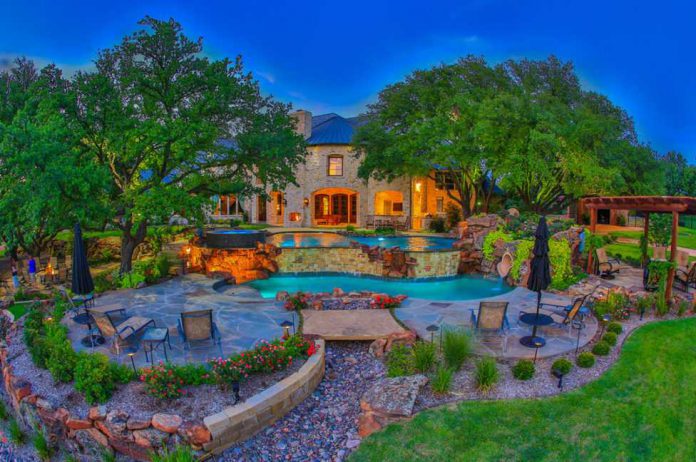
This outdoor environment designed and built by AquaTerra includes all lanscaping, pool, spa, fire pits, outdoor kitchen, bar, pizza oven, multiple televisions, kamado style gill, many elevations, dry creek beds, artisan crafted hand railing, custom slide, elegant lighting, surround sound audio design, and much more!!
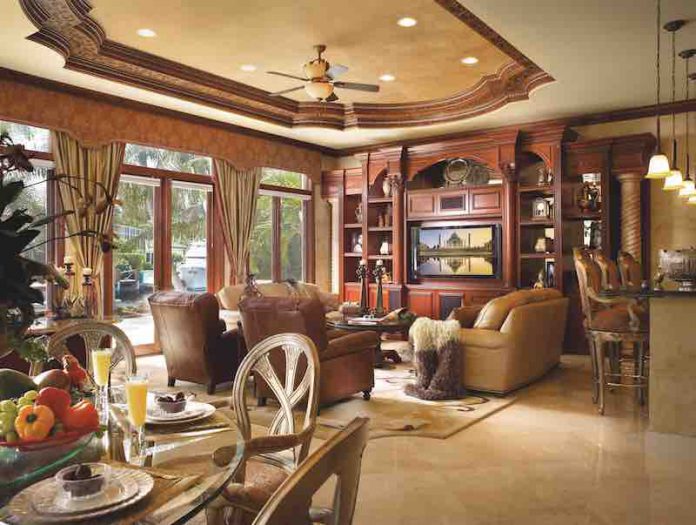
What I like most about creating Old World interiors is the opportunity to combine fine craftsmanship, high quality materials, and, most importantly, the dedicated artistry of many individuals, says Perla Lichi, who just completed the design of this masterpiece home for an Indian couple who live in sunny South Florida.
Gupta-Living Stairs: The lyrical scrollwork of a wrought-iron stairway and balcony railing provides a focal point for the living room while simultaneously luring the eyes skyward. After resting a moment on the landing, where crown molding makes the transition from wall to ceiling, one is immediately drawn upward toward the soaring custom ceiling.
This type of ornate design harkens back to a time when artisans were committed to adding unique artistry to even the most utilitarian of objects, some of which could definitely be considered as works of art, Lichi added. The designer skillfully combined Tuscan, Mediterranean and Moorish styles into the resulting elegant, warm and inviting ambiance in this new two-story home in Bay Colony in Pompano Beach.
Gupta-Living wide: Taken from the base of the stairway, this living room view shows another perspective of the living room, with the fireplace feature wall in the background and the beautifully draped windows that lead to the outside terrace.
The breathtaking, large-volume living room is a visual feast for the eyes. Viewed from one side, the lyrical scrollwork of a wrought-iron stairway and balcony railing provides a focal point while simultaneously luring the eyes skyward. After resting a moment on the landing, where crown molding makes the transition from wall to ceiling, one is immediately drawn upward toward the soaring ceiling.
Gupta-Fireplace vignette: This ornately-detailed bas relief fireplace surround and marble mantle features a most interesting design incorporating traditional acanthus leaf and shell motifs, gargoyles and cherubs.
A unique tri-circular design was created within a larger custom coffered ceiling whose outside perimeter shape is reflected in the area rug far below. An iron-and-crystal light fixture descends from each burnished copper, faux-painted circle that literally glows in upwardly directed lamplight. Scrollwork around the perimeters of each circle repeats the scroll pattern in the wrought-iron railings.
Gupta-Fireplace Vignette: A semi circular, over-size sofa, upholstered in carved chenille, completes the living room seating arrangement. At the center is a round, glass-top, hand-carved wood cocktail table.
Back in the living room, far below, a scrollwork motif is also reiterated in the custom hand-tufted area rug that defines the living room seating area, in the upholstered, hand-carved, painted wooden bench, and elsewhere.
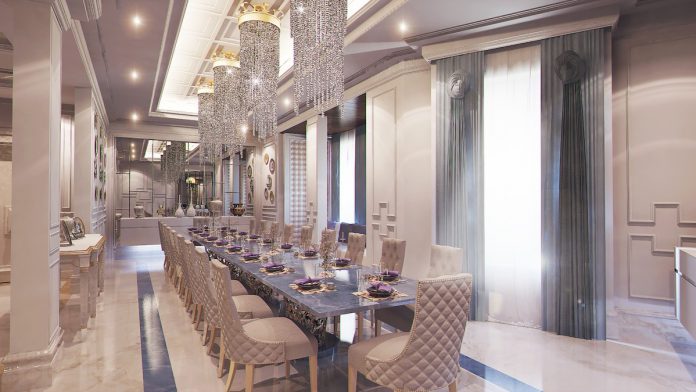
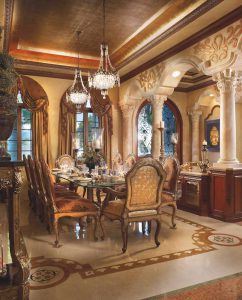
Gupta-dining vignette: Here we can see the entire formal dining room area, skillfully defined with marble Corinthian columns that lead the eye upward. Hand-gilded detailing delights the eye as does the beautifully draped Roman arch windows.
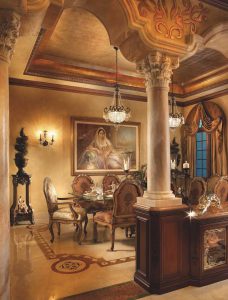
Gupta-dining vignette: A portrait of the lady of the house highlights the feature wall in the dining room, flanked with two candelabra sconces. Notice the gilded, etched of the cabinet doors and the skillful use of marble Corinthian columns.
On the living room wall adjacent to the staircase, a feature wall frames an ornately-detailed bas relief fireplace surround and marble mantle. A roman arch frames a mirrored niche above the fireplace that has been flanked by two floor-to-ceiling, mirrored Moorish-style arches – each with a built-in cabinet below. All three arches are similarly framed using decorative molding with silver highlights to add visual interest.
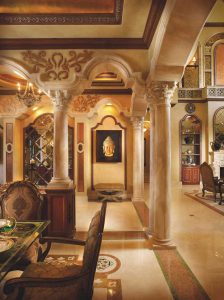
Gupta-dining detail: This closeup of the dining room, looking to the foyer, highlights the hand-gilded decorative motifs that highlight the wall areas along the foyer, at ceiling level, and in the wall space above the columns that define the dining area.
Gupta-Dining Foyer vignette: The foyer is enhanced with a Moorish arch surrounding a floor-to-ceiling mirror created of beveled glass squares set on the diagonal within a wood frame that mimics the shape of the arch.
As the eye moves upward, three even more intricately-detailed, framed arches provide visual symmetry. Geometric Moorish-style design details were skillfully used to create a border for the lower part of the room that also provides a horizontal break from the-floor-to-ceiling movement The square design motifs unite and flow seamlessly from the fireplace wall to the adjacent outside wall where they crown golden silk draperies that frame the outside view.
Gupta-Kitchen: The rustic Mediterranean kitchen begins with soft, golden, faux-painted walls that blend with rich, dark wood cabinets. The kitchen is then further accented by skilled combinations of textures and designs.
The richly appointed living room segues into an intimate formal dining area that is defined by arches flanked with marble Corinthian columns with their distinctive rows of carved acanthus leaves.
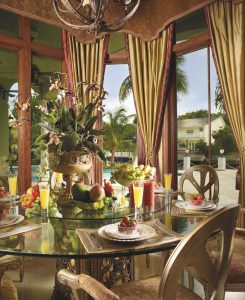
Breakfast anyone? This inviting room features natural light flowing in to highlight a circular beveled glass tabletop with a glass Lazy Susan. The wooden, gilded table base is enhanced with gilding and wrought iron.
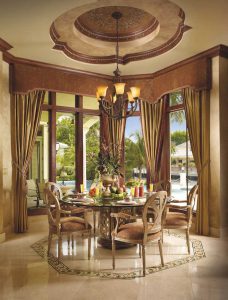
The breakfast room features a round glass table with six upholstered armchairs placed over a custom inlaid marble border motif that adds visual interest and contrast. The distinctive ceiling design was enhanced with a faux-painted leather look punched with silver gilded details.
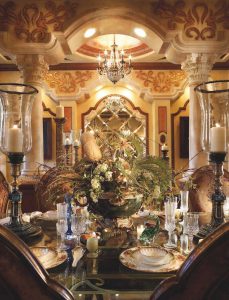
Bas relief motifs within the wall areas at the top of the arches are gilded to enhance their decorative beauty. Crystal-and-iron chandeliers descend from the dining room ceiling. The dining room feature wall presents a large portrait of the lady of the house flanked by two candelabra sconces.
Gupta-Fountain: In a hall adjacent to the large living room a fountain provides visual beauty and soothing sounds of running water that permeate the overall peace and tranquility of this unique interior environment. In the background is a view of the front door and the foyer.
Opposite, a built-in buffet serves as the base for two smaller Corinthian-style marble arches. Gilded, etched cabinet doors reflect and enhance the glittering beauty that surrounds.
Gupta-family vignette: Soft, inviting, leather-upholstered seating was selected for the family?s ultimate comfort and casual relaxation in the family room.
The dining room called for a rectangular ceiling treatment, highlighted with gold leaf, to mimic the custom rectangular gilded, etched glass-topped formal dining table and provide a suitable frame for the two classic crystal chandeliers. Softly puddled golden silk draperies frame the arched windows.
The wrought iron seen through the columns is the double front door. With its ageless beauty and European feel, marble, polished to perfection, enhances the floors and Corinthian columns that reach upward with elegance. The stairway is also of marble, with front insets that coordinate with the overall color palette. Hand applied finishes create further visual interest in every room and the designer’s own master faux painters added a most distinctive warm glow to the entire ambiance.
Gupta-Master bath: The master bath features a step-up Roman tub and his and hers European-style vanity cabinetry in bone. A custom motif within the marble floor reflects the shape of the custom ceiling above.
Planned for the family’s ultimate comfort and casual relaxation, the family room features a floor to ceiling built in cabinet that houses the audio and video equipment and also provides ample room for display.
Gupta-powder room: The powder room vanity area is highlighted with European-style cabinetry with accents of burnished gold and magnificently faux-finished walls with over-sized gilded decorative crown moldings. An ornate framed mirror is flanked b two candelabra sconces.
Soft leather-upholstered furniture is enhanced with coordinating and contrasting pillows in soft fabrics of silk and chenille and a hand-knit Perla Lichi trademark throw.
A tufted area rug picks up the motifs and colors from the rug in the living room.
A family home theater is decorated in tones of deep maroon, beige and gold.
Gupta-Master bed: The master bedroom features a carved wooden bed highlighted with burnished gold highlights. Custom sculpted carpeting in bone adds subtle pattern underfoot while a faux painted custom ceiling is framed with a decorative wood molding also highlighted in burnished gold.
A custom built-in cabinet provides ample storage for the equipment and another opportunity for the designer to introduce Corinthian columns, this time in wood. Beige suede theater
Gupta-Master bed sitting: Within the master bedroom, one steps up to a most inviting seating niche featuring a Moorish-style, oval, fringed area rug. Arabic-style cushioned seating surrounds the perimeter. The cozy ambiance was created with inviting upholstered furniture and a softly draped window.
seating features over-sized comfort. Framed upholstered wall motifs add visual interest and improved acoustics.
The rustic Mediterranean kitchen begins with soft, golden, faux-painted walls that blend with rich, dark wood cabinets and is then further accented by skilled combinations of textures and designs. Paisley fabric, another Moorish touch, was selected for the kitchen bar chairs. A unique octagonal soffit that houses kitchen ceiling lighting is decorated with framed, faux-painted geometric shapes and surrounded by evenly spaced wooden corbels.
Gupta-Theater: A family home theater is decorated in tones of deep maroon, beige and gold. A custom built-in cabinet provides ample storage for the equipment and another opportunity for the designer to introduce Corinthian columns, this time in wood.
The master bedroom features a carved wooden bed highlighted.
with burnished gold highlights. Custom sculpted carpeting in bone adds subtle pattern underfoot and complete noise absorption to enhance the ambiance. A custom ceiling features a burnished gold crown framed with decorative wood molding highlighted in burnished gold. At one end of the room, one steps up to a most inviting seating niche featuring a Moorish-style, oval, fringed area rug.
Gupta-Living Aerial: This living room aerial view highlights the large volume of the room, the scope of the unique coffered ceiling, the fireplace feature wall, and the seating arrangement over the hand-tufted custom area rug.
Arabic-style cushioned seating surrounds the perimeter. The cozy ambiance was created with inviting upholstered furniture and a softly draped window.
The master bath features a step-up Roman tub and his and hers European-style vanity cabinetry in bone. A custom motif within the marble floor reflects the shape of the custom ceiling above, enabling the designer another opportunity to introduce scrollwork and Moorish-style motifs. A subtle gold-and-cream palette is softly enhanced with punches of the color jade.
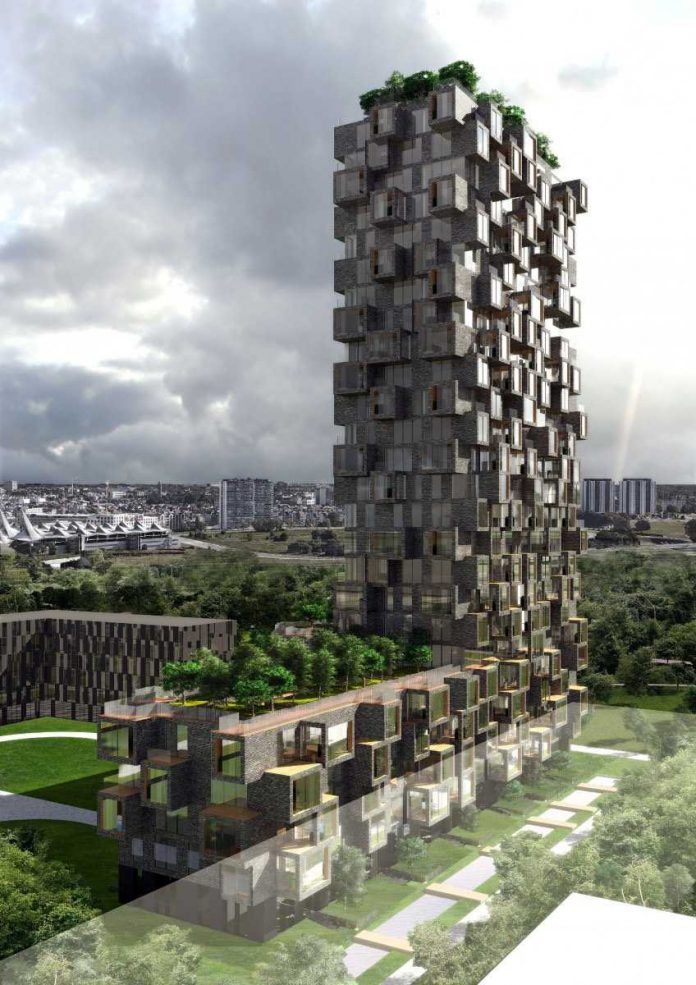
Our project is an interpretation of a specific idea of urbanism which establishes rules and allows for the possibility of diversification. What we propose is actually a variation on an urban subject, implementing a set of rules and actions that were already fixed in a masterplan in a creative and intuitive way.
It is a variation on the typology of tall buildings. Our project differs from the well-known concepts of skyscrapers and tall buildings, the former being structures that become icons by descending from the sky towards the ground in a deus-ex-machina kind of fashion, the latter being understood simply as a vertical extrusion of the ground towards a certain elevation.
An urban tower is not a skyscraper nor a tall building. An urban tower has a rational structure, a body that engages in a dialogue with both the sky and the ground, and it is in this act of interconnecting these two fundamentally different spheres that its identity and origin lay. Our proposal for this residential tower introduces the concept of variation, acting both on the skin and the shape of the building.
It does not strive to be a unique and isolated element, but the catalyst in a series of alterations of the urban tissue. It finds a balance between the formal rigor of a rectangular plan and the heterogeneity of a porous body, between the rigidity of planar surfaces and the alterations introduced by the pixelated extrusions.
In our urban tower, the inner space tries to constantly expand towards the outside. A series of balconies and loggias attempts to generate a certain surplus space for itself while, at the same time, blurring the border between interior and exterior. On a larger scale, the tower establishes a relation with the river and the Antwerp landscape beyond. A contemporary shape, reaching out to the sky of the local urban landscape by exploring the construction material and tectonic possibilities. It is a symbiotic merging of material, constructive traditions and contemporary living standards. A sober, sophisticated tower that enriches and respects the urban context that will be growing around it.