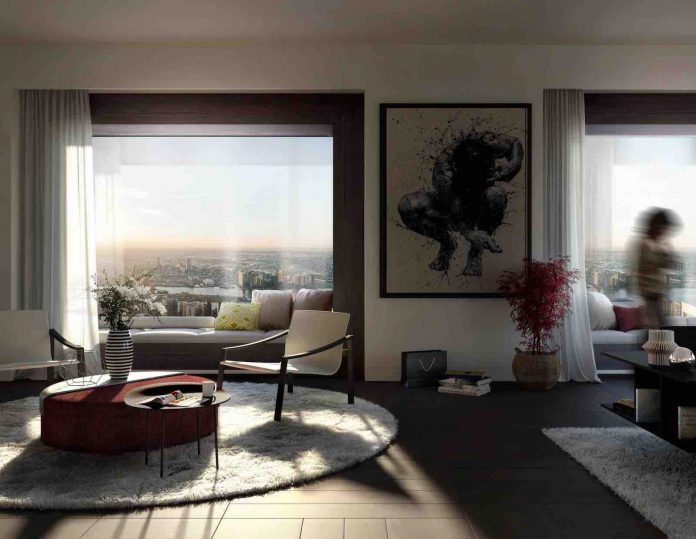
Matteo Nunziati signs the interior of a 767 square meter penthouse inside the 432 Park Avenue skyscraper in New York. 432 Park Avenue is an exclusively residential building, located in the heart of Manhattan and a short distance from Central Park. Completed in 2015, with its 426 meters high and 96 floors it is considered the third tallest skyscraper in New York however, considering the only height to the roof is the tallest building in the city. The architectural project is made by the architect Rafael Violy. The building is characterized by a very essential and rigorous design. The common areas are characterized by an extremely minimalist design, clean lines, regular spaces well illuminated by the numerous windows. The 432 Park Avenue also has 2,800 square meters of areas dedicated to common services for residents such as a billiard room with a library, meeting room, cinema hall, children’s area and a wine shop with controlled temperature; on the 16th and 18th floor there is a large equipped gym including fitness area, showers, sauna, turkish bath, jacuzzi, yoga room, massage rooms and a 23 meter long pool. The restaurant on the 12th floor, managed by the chef Shaun Hergatt, is exclusively dedicated to residents and their guests and also offers a catering service at home on request. On the ground floor there is a large concierge service where you can also book various services such as laundry, domestic staff, driver, taxi, restaurants and entertainment ticket office. The 104 units are of different sizes from 250 square meters to a 767 square meters luxurious penthouse and all include a double entrance, private elevator with direct access, underfloor heating, sophisticated home automation systems and fine finishes. From the 88th to the 95th floor are the penthouse, which each occupy all 767 square meters of each floor. Recently one of these penthouses has been sold for 95 million dollars considered as one of the most expensive apartments in the world. For the interior design Matteo Nunziati covered the large square windows with a frame in eucalyptus wood with integrated cooling systems, LED lighting and automatic curtains. This frame enhances even more the elegance of the iconoc large square windows. The floor is covered by Fox Trot a square plank in wenge wood designed by Nunziati for Listone Giordano. The furniture has been selected among the most prestigious international companies, in particular for the living area Nunziati selected the Allure armchair and the Trevi coffee tables designed by Nunziati for Molteni & C and the Filigree table with Chelsea chairs for the dining room. In the Family Living, the breeze sofa designed by Nunziati, the D153.1 armchair and the D.552.2 table designed by Gio Ponti. The furniture and finishes create a contemporary athmosphere, but at the same time warm and timeless.
Melody Homes
The site for the new residential building is located on plots no. C41, C42 and C43 sector S3 Shams Abu Dhabi with plot area of 7.726 m2.
Facing Abu Dhabi’s present and future landmark buildings, Melody Homes was designed to deliver the utmost in personal and business needs within a contemporary villa environment. Using the noblest of contemporary materials, the philosophy behind Melody Homes was always to create a new concept in urban living, a concept that offers its residents the unique choice of self-contained villa living or a more social lifestyle with access to luxuries beyond one’s own residence.
Mminimalistic and sophisticated, yet classical, villa-style residences that were designed to be distinctive from the existing luxury housing market in Abu Dhabi.
Melody Homes Interiors the perfect harmony
The site for the new residential building is located on plots no. C41, C42 and C43 sector S3 Shams Abu Dhabi with plot area of 7.726 m2.
Studio Marco Piva proposed architecture and the colaboration of Andres Escobar Assocciates for the interior, studying the better way to explain that exteriors and interiors must speak the same language, ensure that Melody Homes is in perfect harmony. It was created minimalistic and sophisticated, yet classical, villa-style residences that were designed to be distinctive from the existing luxury housing market in Abu Dhabi.
Facing Abu Dhabi’s present and future landmark buildings, Melody Homes was designed to deliver the utmost in personal and business needs within a contemporary villa environment. Using the noblest of contemporary materials, the philosophy behind Melody Homes was always to create a new concept in urban living, a concept that offers its residents the unique choice of self-contained villa living or a more social lifestyle with access to luxuries beyond one’s own residence.
The House Boat
This architecture that thrives on open space, white, lucid surfaces, springs from the place where it is anchored, at the extremity of the new Gallipoli. We are 12 meters away from the Ionian Sea, on an irregular lot that embraces the stunning visual cone of the sun at sunset, and a series of views of the old city, with its splendid maze of little streets, houses and churches, of great historical value, says Ludovica Serafini.
The environmental qualities of the context had to be exploited, inspiring the whole project: three years of construction with specialized work teams, imported from afar. We are used to working on a zero-km basis, reducing waste and striving for visual immediacy, both in design and architecture, divesting the object of any non-intrinsic values; but in this case the need for technical isolation of the house from the water was so complex that it required two levels of excavation with respect to the street level, using materials and workers not from this zone.


The effect we were looking for was something like that of a riad that conceals its wonders inside, a life independent of the context. Here’s the mental and physical detachment is provided by a small courtyard that creates privacy, and on a practical level hides the service areas behind a wall transformed into a blade of water.


In the company of large olive trees, from the courtyard one reaches the entrance of the house, organized on three above-ground levels plus a terrace, with the semi-basement set aside for cars, technical equipment and the rooms of the servants. The ground floor contains the spaces for entertaining, and the spa with an indoor swimming pool and wellness islands, closed by an opaque glazing.
The sculptural white helical staircase starts here, cutting through and connecting all the levels, freed as much as possible from structures and partitions, for a perceptive effect of dematerialization, air and lightness, all the way to the terrace.
The staircase was made as a one-off, assembled at the workshop and brought in which a helicopter a complex object: since the floor slabs are at different heights, each portion had to be precisely calculated, Palomba explains.

At the first level, the bedrooms are ample spaces with their own bathrooms, while the main room is closed by a full-height corner window for a view of the sea. The second level contains a fluid sequence of living spaces, with a two-story zone, conceived as a greenhouse with large plants inserted at strategic points, connected to the super-tech kitchen island that conceals, behind cabinets, a specially designed super-hood for frying, custom-made for this house.
Italian luxury interiors in Vienna
Dome Milano Interior arrives in Vienna with a new proposal of Italian luxury interiors that, from the beginning, wanted to highlight a sophisticated and refined style. A curated selection of furniture from Italian brand collections to shape high end interior designs.
The penthouse, the protagonist of this design project, is located near the center of Vienna, in an entirely residential neighborhood, surrounded by calm green spaces, where the family with five children lives.
The project was based on careful research into Italian luxury interiors to satisfy every need and lifestyle. The feeling we sought to achieve is that of being able to find oneself in a welcoming, bright, and elegant space.
This luxury house interior project is spread over the last floors of a Viennese building and occupies the entire floor plan of the building. This particular distribution allowed for the creation of naturally luminous spaces in direct contact with the outdoor thanks to a unique wraparound terrace.
The multiple floors create dynamism inside the house and gives life to a progression of spaces. You enter into the living area, the beating heart of the apartment, and as you go up towards the other rooms, you arrive at the more private spaces of the apartment, where you find the children’s rooms and the master bedroom.
Finally, the last flight of stairs leads to a large terrace that completes the project and offers the family a peaceful open space surrounded by the greenery of the neighborhood.
Throughout the house, you can get the sense of a common theme with an exquisite taste suited to Italian luxury interiors: bronze, white and dark Emperador marble, sand-colored leather, and light, luminescent wallpaper are the common denominators of this project. We can find this alternation of colors both in the finishes and in the furnishing elements.
GRAND HOTEL ET DE MILAN BY DIMORE STUDIO
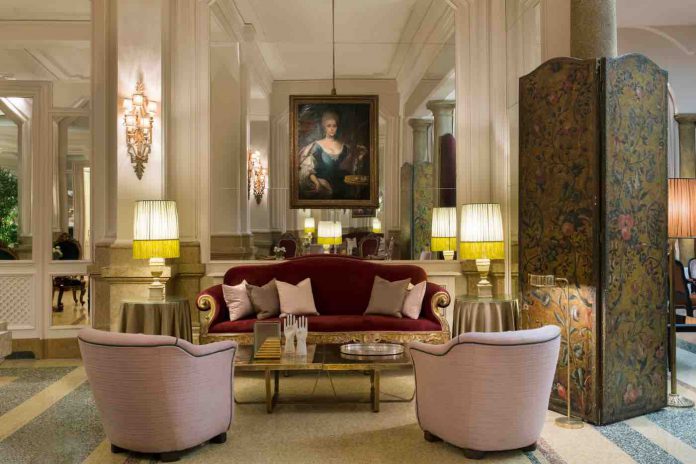
Dimorestudio concluded a restyling intervention at the iconic Grand Hotel et de Milan. The hall and bar areas are renovated with elegant contemporary touches, through new colours, materials, carpets and finishings, whilst preserving the historical atmosphere and essence of the spaces.
The discreet and refined Gerry?s bar now flourishes through delicate touches of pink, rust and golden hues.

A rich palette of pinks and greens, precious velvets, silks and jacquards establish a common thread between the hall and bar, infusing new life in the marble surfaces, the works of art, the 19th-century fireplace, the ancient table and the terrazzo flooring.

Bottle green and orange hues are respectively juxtaposed with bordeaux and muted pink embroidery. Compelling floral patterns on smooth fabrics adorn the hall sofas, while exotic and liberty motifs stand out on the cushions and stools of the bar area.

Furniture pieces are also embellished with fringes, which are present on newly added pastel colored lampshades in pleated raw silk.? The soft, welcoming diffused light creates a profusion of pale pink accents, the same tonality chosen for the paint of the walls.

The optical effect of the carpet revitalizes the hall with its colorful geometric patterns, both blending and contrasting with the classic ambient.
The ensemble endorses the sophisticated retropolitan allure of the private lounges ? refined after-theatre scenarios that can be fully lived until late at night.
The result is a unique intersection between past and present that perpetuates the charm and timelessness of the venue, creating an enchanting impact in a place where time seems to stand still.
Double Tree by Hilton, Trieste
The DoubleTree by Hilton hotel is located in the city of Trieste, a border land opens to the sea, a harbor centenary and has always been a fertile arena of culture and traditions. The design of this hotel located in a historic building of the ‘900 with great architectural value has proved to be a stimulating challenge. From on the one hand there was the will to preserve its original characteristics, respecting its architectural constraints and eliminating the superfetation of recent decades, on the other hand there was a need for these intentions to merge with the practical aspect of managing a hotel space, giving this place a reminiscent of time appearance but with a captivating and contemporary design.
Inside the building there was a historical library dear to its inhabitants that determined the intention to make of this hotel a space open to external visitors, which gave them and the Trieste residents the possibility to enter the building to enjoy the bar and restaurant services.
For the design of the structure it was decided to adopt two different stylistic approaches, one celebratory and another of strong entity, which change according to the context they are supposed to inserted in. The common areas have been placed in the heart of the building, inside rooms rich of decorated woodwork, inlaid floors and majestic chandeliers. At the entrance, where you are welcomed by an imposing fountain of the gladiator and lions, a non-invasive approach has been developed with refined reception desks with mirror effects with the intent of hiding out in order to reflect the surrounding context.
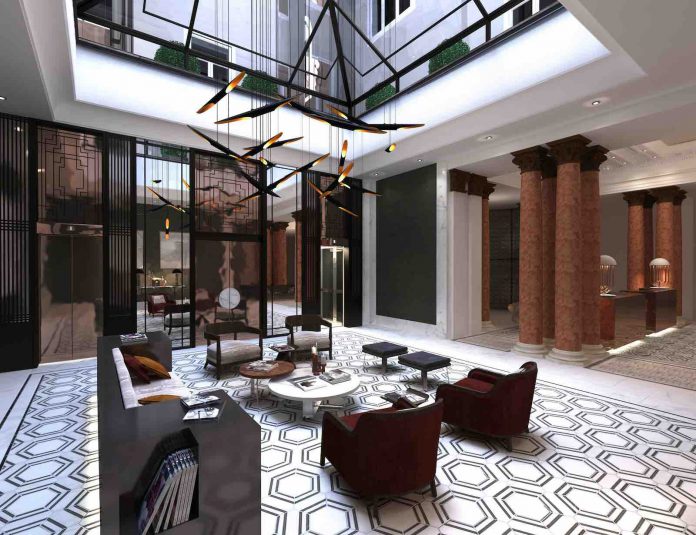
In the opposite case, environments of great visual impact have been recreated inspired by the eclectic aesthetics of Trieste. The lift lobby is an example of this: a passage area that winds under a pyramid-shaped glass cloister, creating a set of lighting features designed to be eye-catching. The precious coverings of the panoramic lifts and the elegant but absolutely flexible design of the upholstery make the space rich and fully integrated into the context.
The bar?s historic lounge features contemporary design elements combined with restored historic seating, framed by a gold coffered ceiling. The same applies to the eccentric bar counter, which is placed in a room enriched with a historic leather paneling and declares its contemporaneity by recreating an intimate atmosphere typical of the cigar room.
For the 125 rooms the aim was to diversify the types between standard and suite. Also in this case, some rooms have been created within areas rich in historical references in which the furniture has been inserted entirely preserving the floors and walls and keeping the original chandeliers.
On the top floor, in order to make the most of the lighting offered by the existing skylights, light wells were created.
The bathrooms are covered in statuary marble, which gives great light to the environment. Custom-made furnishings and rich, warmly colored fabrics complete the luxurious and welcoming atmosphere of the rooms.
The Magnificent eight Marie Claire house by Bruno Tarsia
Bruno Tarsia, architect and interior stylist, lives and works in Milan.
With a versatile and eclectic taste, he produces editorial photo shoots , commercial catalogs, exhibitions and advertising campaigns, but also interior design for private clients and showrooms. Following his experiences in the field of interior decoration, he also works as a set designer for fashion photo shoots.
His work aims to combine with a poetic and creative touch, imagination, reality, elegance and attention to detail. Whilst his in-depth research encompasses different styles specializing in a balance of chromatic dichotomy.
NO SEX BY ATELIER BIAGETTI
NO SEX
And so it continues, Alberto Biagetti and Laura Baldassari?s lucid and intensely personal examination of the world around us, of the society we live in and of the manias and fashions of contemporary life.
After BODY BUILDING, last year?s glossy and ironic episode in which the creative couple revisited the world of the gym, underlining the excessive pursuit of the perfect body and the stereotypical idea of beauty, NO SEX can be considered the second volume of the same chronicles. This project looks at the facts and tendencies of the world around us. Once again it involves the body but this time Biagetti and Baldassari go even deeper, into the psyche, to concentrate on the perception and the accessibility of sex in the world today, bombarded as it is by ever more excessive and explicit images made available to anyone at any time thanks to the internet. Sex has always been the taboo subject par excellence but, over the last couple of decades, it has been generally accepted by society (although never quite completely) and, thanks to the advanced communication technology that we so take for granted today and which has really superseded printed media in this sector, ways of ?consuming? it have changed radically making it accessible to the masses and in many different forms. The sex portrayed here is ascetic yet intriguing; it is seductive, encouraged, even commercialized, and is made attainable in a futuristic, imaginary environment ? more or less real ? who?s to say just how real. The two designers have looked to the habits, practices, uses, methods, fetishes and passions, but also to the addictions and contradictions, the conflicts and personal inclinations that sex generates in the world today. NO SEX goes beyond the analysis of appearance and of aesthetic beauty to create a sort of secular Eden, a refuge or even a sci-fi pleasure-house where it is possible to achieve both psychological and physical completeness on demand.
NO SEX is intentionally ambiguous and, although it is the personal expression of a precise point of view, is open to interpretation. It examines the precariousness of human relationships in a frenetic contemporary lifestyle; it addresses the subject of certain inclinations and other compulsive cravings as well as primal desires and of needs induced by the bombardment of hot images in the media. As well as the specific subject matter that is treated in NO SEX, another key point is Biagetti and Baldassari?s singular approach to their work. Just as in 2015, this project (that takes the form of a collection of different products) is the result of a creative outlook, of the desire to tell a story by transforming the conditions of the things that surround us, turning them into a multi-faceted narrative made up of objects. This characteristic artistic direction can therefore be considered almost a collection of short-stories that illustrate a personal analysis of this period in history offering us an individual, perhaps even futuristic, interpretation of it.
Just like at the cinema when we are engrossed by the onscreen action, here we must immerse ourselves in the affairs depicted by the objects, the protagonists of the narrative. If Biagetti and Baldassari had had a video camera, NO SEX might have been a film, or if they were writers it may have been an actual short story but as it is, their chosen language is design and with their collections the duo present 3D storyboards that are also functional in everyday life. For this project Laura and Alberto chose soft, malleable, indefinable, even carnal materials such as natural rubber, latex and the highest quality leather in nude pink. There are almost endless ways of interpreting the story told here: perhaps it describes a world where sex is no longer considered healthy but is instead commercialized and disparaged, in which the pink-clinic of Biagetti and Baldassari is a kind of detox, a way of liberating oneself of one condition and of reaching another in which we can freely and spontaneously express our sexuality. Or perhaps it is a refuge from the constant, invasive bombardment of erotic images that we are subjected to in the world today ? a place to feel satisfied, safe, protected and cared for.


Or is it a sort of pleasure-house where you can purify yourself from online porn? NO SEX is intentionally enigmatic, elusive, uncertain and equivocal. Captivating yet distant, concise yet enchanting, exempt of moral prejudices, never vulgar, and filled with a good dose of inventiveness and fervid imagination ? combined with the impeccable manufacture of the objects themselves ? this creative project does not sit in judgement or pass any verdict. It is rather a sort of analysis and although it may be appreciated, accepted, understood or identified with more by some than by others, it remains the personal vision of the two authors whose subjective, courageous and strongly aesthetic expressive language draws on the life they observe in the world around them. Over to you. “Maria Cristina Didero”
THE BEST 25 INTERIOR DESIGNERS OF MILAN
MATTEO NUNZIATI
Matteo Nunziati is a good example of a person whos had it in him for the arts since the beginning. Born in Bologna in 1972 hes currently regarded as one of the most influential designers and architects with Italian origins that the two industries have ever seen.
Nunziati is proud of telling the story of how he dreamt of becoming a top designer: When I was a boy during high school, my teachers got angry because I was drawing during class hours. For me, drawing has always been a passion and a pleasure. For this reason I consider my work to be the most extraordinary, because I do what I like and someone pays me to do it!
It was with this very same mindset that Matteo Nunziati decided that architecture and design were the future for his career. He began giving his first steps into the industry when he opened his own interior design studio in Milan all the way back in 2000. Alike many of Italys top interior designers and architects, Nunziati is the perfect example of a person who definitely manages to transpire the best of the Italian style into his projects, by providing his clients with the best luxury furniture and finishes with the Made in Italy mark well present.

Matteo Nunziati, aside from having potential partnerships with top luxury furniture brands such as Molteni & C., Poliform, Lema, Flou, B&B Italia, Poltrona Frau, Giorgetti, Flexform, Minotti, among many other top-players, hes been handling a variety of establishments such as Luxury hotels, Residences, Wellness Centres, and Spas. Amongst one of the main highlights of his career, its important to mention his work on the take on the Trump Towers which earned him many compliments from the current President of the United States himself.

When it comes to present projects Nunziati is currently busy with the design of the Trump Towers in New Delhi and Kolkata in India, The Oryx Tower by Qatar Airwaysin Doha, Aston Martin Residences in Miami, the renovation of the suites at the Four Seasons Hotel London at Park Lane, the renewal of the Trump National Spa in Doral, Miami, as well as other relevant projects within three villas in Oman, one villa in Singapore and one in Dubai. Regarding the design product the designer has revealed that hes preparing new products for Molteni & C, Lema, Fiam, Rubelli Casa and other top bespoke brand names. Despite the fact that these are very different projects in more than one design are, Matteo Nunziati revealed to us the general take he usually gives to these projects.

They are all different projects. In general, I can say that I am looking for the soul of the project. I find this soul in the tradition and the emotion transmitted from theplace where it is built. In the product, I find it in the history of the company and in its specific ability to create a piece of design.
The conversation with the Italian designer was long and productive, however, when it came to pointing to what he believed would be the main focus of the design world in the future, Nunziati gave a hopeful reflection regarding the impact he hopes interior design will still continue to make worldwide.


Marco Piva